
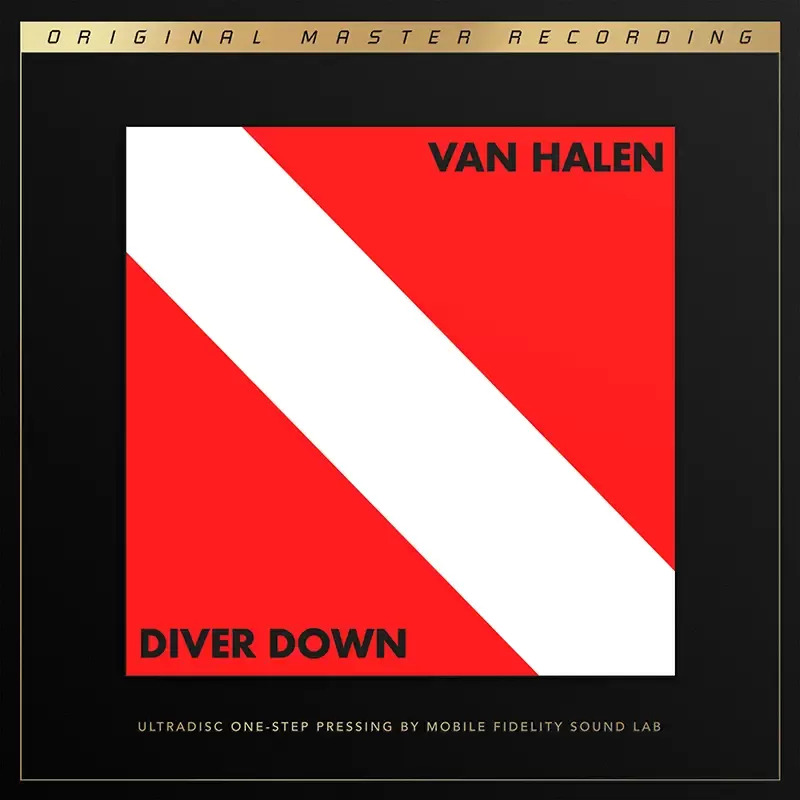
Van Halen Diver Down 45RPM SuperVinyl Ultradisc One-Step Box Set (2 LP)
- Бренд
- MOFI
- Артикул
- 0821797203623/UD1S 2-036
UltraDisc One-Step 45rpm 180g 2LP Box Set!
Pressed at Fidelity Record Pressing!
Strictly Limited to 7,500 Numbered Copies!
1/4"/15 IPS Analog Master to DSD 256 to Analog Console to Lathe!
Van Halen's grueling touring schedule – coupled with the production of four LPs in four years – prompted the American rock band to take a break. However, the break did not last long. Singer David Lee Roth felt that the record label's desire for new music could be satisfied by covering "Dancing In The Street" by Martha & The Vandellas and releasing it as a single. Guitarist Eddie Van Halen, who didn't just want to copy another artist's song, but wanted to transform it, suggested Roy Orbison's "(Oh) Pretty Woman" when he couldn't think of a suitable riff for the Motown song. Case closed? No, not at all: When the Van Halen rendition of the Orbison classic stormed the Billboard charts and climbed into the Top 15, Warner Bros. told the band that a whole album would be needed to meet the high demand. So the quartet went to Los Angeles with Ted Templeman to record their fifth studio album at Sunset Studios and Warner Bros. Recording Studios, between January and March 1982 – in just 12 days. So much for the genesis of "Diver Down", which was released in the same year, immediately shot to number three in the US charts, and sold over four million records worldwide!
Van Halen's success story with cover songs can be traced back to her diamond platinum debut in 1978. The ambitious approach, which brings out the versatility, creativity, flair and joy of playing of the band, is more in the foreground than ever on "Diver Down". The album features five rousing covers, three of which became major radio hits: the energetic rendition of the Kinks song "Where Have All The Good Times Gone!", the barbershop quartet parody of "Happy Trails" – originally by Dale Evans – and, of course, "Oh, Pretty Woman". Between these tracks there is a hodgepodge of extremely playful pieces. Take, for example, the menacing "Intruder," written by Roth on synthesizer and carried by Eddie Van Halen, who spins the tremolo bar of his guitar and rubs a can of "slot" against the strings while it gives vigorous feedback. Or the visionary "Little Guitars (Intro)", in which Eddie Van Halen plays a nylon string guitar and imitates a classically influenced flamenco technique by quickly tremolo-picking the high strings with his right hand and orchestrating hammer-ons and pull-offs on the guitar neck with his left hand. Always one step ahead, the pioneering instrumentalist composed "Cathedral" long before the recordings for "Diver Down". He adapted it for the record by fingering the notes on the fretboard with his left hand and simultaneously turning the volume knob up and down with his right hand. The latter eventually caused the knob to jam at the end of the second take, but the intended effect – a piece that resembled the sound of a church organ – was successfully captured.
Van Halen's winning track record with cover songs can be traced back to its 1978 diamond-platinum debut. The ambitious approach, which shows off the band's diversity, creativity, flair, and fun, takes precedence like never before on Diver Down. Featuring five covers, three of which became radio staples, the album sprung from the band's desire to remain relevant while taking a breather after four massively successful records and their respective tours. More than four million copies later, suffice it to say Diver Down achieved its goal.
Sourced from the original analog tapes, pressed at Fidelity Record Pressing, and strictly limited to 7,500 numbered copies, Mobile Fidelity's UltraDisc One-Step 180g 45RPM 2LP box set presents the 1982 album in definitive sound. All the traits you associate with hallmark Van Halen — dynamic energy, distinctive tonalities, vivid detail, sensory-invigorating immediacy, rhythmic attack, tongue-in-cheek playfulness, midrange punch, throttling intensity — emerge with involving presence and uncanny realism.
Recorded with producer Ted Templeman in just 12 days in California, Diver Down can here be experienced with unparalleled transparency, balance, definition, and, if you so choose with your volume settings, concert-like solidity, scope, and decibel levels. Provided your system is up to the challenge, you can crank this version as high as you want without risking noise-floor interference or shrillness. Even if you listen at lower levels, the advanced degrees of separation, imaging, soundstaging, and fullness will grant you a fresh perspective on a record that began under the auspices of a one-off single.
The premium packaging of this UD1S pressing befits its collectible status. Housed in a deluxe slipcase, it features special foil-stamped jackets and faithful-to-the-original graphics that illuminate the splendor of the recording. Aurally and visually, this UD1S reissue is made for discerning listeners who desire to immerse themselves in everything involved with the album, from the naval-inspired cover art to the interior photos, which range from a spirited collage to a panoramic shot of Van Halen thrilling a crowd of tens of thousands in Florida.
Indeed, the group's punishing live schedule — coupled with making four LPs in four years — prompted Van Halen to seek some refuge from the road and studio. The break didn't last long. Vocalist David Lee Roth thought the band could placate the record label's desire for new music by interpreting Martha & the Vandellas' "Dancing in the Street" and issuing it as a seven-inch single. Guitarist Eddie Van Halen, intent on not simply replicating another artist's song but transforming it, suggested Roy Orbison's "(Oh) Pretty Woman" when he couldn't get an immediate handle on a riff for the Motown tune. Case closed? Not so fast.
When the joyous romp through the Orbison classic crashed the Billboard charts and climbed into the Top 15, Warner Bros. brass told Van Halen it needed a full-length effort to take advantage of demand. And so the loose, diverse feel of Diver Down took shape, with the band exploring a wide palette of influences and entertaining widescreen desires on what stands as its most carefree set of its career.
Diver Down may be best known for the three electrifying covers that still ring out on FM airwaves today, yet what makes the record much more than a quickly thrown-together collection of odds 'n' ends is the vast assortment of styles represented — and the group's all-in performances. Not to mention some of the subtle messaging. To wit: The band's hot-wired take on the Kinks' "Where Have All the Good Times Gone!" doubles as a jab to the pretenders crowding the music scenes, and a call for the kind of authenticity and skill Van Halen brought to every note it played. Equally pointed, the barbershop-quartet send-up of"Happy Trails" functions as a quasi-parody and the quartet's winking way of having a laugh with those who can't take a good joke.
Bookended in between those tracks exists a hodgepodge of fun, exuberant material. Consider the three standout interludes. Written by Roth on a synthesizer and anchored by Eddie Van Halen twirling the tremolo bar on his guitar and rubbing a can of Schlitz against its strings amid substantial feedback, the menacing "Intruder" conjures the vibe of Van Halen's preceding Fair Warning. On the opposite end of the spectrum, the visionary "Little Guitars (Intro)" sees Eddie Van Halen wielding a nylon-string guitar and replicating a classically informed flamenco technique by quickly tremolo-picking the high strings with his right hand and taking his left hand to orchestrate hammer-ons and pull-offs on the guitar neck.
Always a step ahead, the pioneering instrumentalist devised "Cathedral" long in advance of the Diver Down sessions. He tailored it for the record by fingering notes on the fretboard with his left hand and using his right hand to simultaneously roll the volume knob on and off. Doing the latter eventually caused the knob to freeze at the end of the second take, yet the intended effect — a piece that resembled the sound of a church organ — was successfully captured.
Having peaked at No.3 and spent more than a year on the charts, Diver Down also includes atomic-punk fury ("Hang 'Em High"), gentle tranquility ("Secrets"), and a stripped-down jaunt through the old jazz ditty "Big Bad Bill (Is Sweet William Now)" complete with a guest contribution from the Van Halens' father, Jan, on clarinet. With the album title and artwork aptly hinted that something was happening underneath the plain visibility of the surface — while simultaneously serving as a sexual double entendre — Diver Down remains the band's most overlooked and surprise-filled platter. One that the original marketing campaign saliently noted finds the band's "temperature up." Happy trails, indeed.
The numbered double LP by Mobile Fidelity, strictly limited to 7,500 copies, was remastered especially for this edition in the Californian MoFi studio and pressed on 180 gram SuperVinyl (45 rpm) using the sonically superior UltraDisc one-step process. The records are housed in foil-embossed sleeves, the luxurious slipcase comes with the true-to-the-original graphics that underline the sonic splendor of the new edition. Enormous realism and rousing presence with unbridled clarity, dynamics and attention to detail: "Diver Down" offers more rock feeling than ever thanks to the MoFi one-step version - turn up the volume control!
More About Mobile Fidelity UltraDisc One-Step and Why It Is Superior
Mobile Fidelity Sound Lab's UltraDisc One-Step (UD1S) technique bypasses generational losses inherent to the traditional three-step plating process by removing two steps: the production of father and mother plates, which are created to yield numerous stampers from each lacquer that is cut. For UD1S plating, stampers (also called "converts") are made directly from the lacquers. Since each lacquer yields only one stamper, multiple lacquers need to be cut. Mobile Fidelity's UD1S process produces a final LP with the lowest-possible noise floor. The removal of two steps of the plating process also reveals musical details and dynamics that would otherwise be lost due to the standard multi-step process. With UD1S, every aspect of vinyl production is optimized to produce the best-sounding vinyl album available today.
Why Isn't This UD1S Pressed on MoFi SuperVinyl?
Diver Down is one of the few Mobile Fidelity Sound Lab UltraDisc One-Step releases since the advent of MoFi SuperVinyl that is pressed on 180g black vinyl rather than MoFi SuperVinyl. Why? Quite simply, it sounds better on 180g black vinyl. After closely auditioning Diver Down on several different vinyl profiles — a time-consuming and expensive endeavor no other label pursues — MoFi's expert engineers determined the music on this 1982 album translates with superior definition, clarity, presence, dynamics, and balance on this format. The opening of MoFi's sister plant, Fidelity Record Pressing — and its peerless ability to press dead-quiet 180g black vinyl — means the label's engineers now have more options when it comes to high-quality vinyl. All of which benefits the original artists and their intent, and you, the listener.
Features:
- Numbered, Limited Edition - 7,500 Copies
- UltraDisc One-Step
- 180g Vinyl
- 45rpm
- 2LP Box Set
- 1/4"/15 IPS Analog Master to DSD 256 to Analog Console to Lathe
- Pressed at Fidelity Record Pressing
- Deluxe Slipcase
- Special Foil-Stamped Jackets
- Faithful-to-the-Original Graphics
Selections:
Side A
1. Where Have All The Good Times Gone!
2. Hang 'Em High
3. Cathedral
Side B
1. Secrets
2. Intruder
3. (Oh) Pretty Woman
Side C
1. Dancing In The Street
2. Little Guitars (Intro)
3. Little Guitars
Side D
1. Big Bad Bill (Is Sweet William Now)
2. The Full Bug
3. Happy Trails